Showing posts with label Connecticut River Logging. Show all posts

Thursday, August 20, 2015

Stories from the River, Death of George Van Dyke


George Van Dyke was the primary lumber baron on the Connecticut River during the Guilded Age. Like many Guilded Age legends, he was a larger than life figure who could be capricious and contradictory, trying to get away with disobeying the law to make a profit, swindling landowners and hired labor one minute, and helping them out the next.

George was a strict taskmaster to his employees. He hired hundreds of workers and knew them all. He never tolerated bad behavior in the towns along the river. If a worker of his was caught vandalizing or stealing he was fired on the spot. He was actively involved in every stage of the logging process. He personally supervised his logging camps, and if a worker overslept, George would go into the bunkhouse bellowing at the top of his lungs and kick the shirker in the ribs.

During log drives, he followed the logs down the river, personally supervising the whole operation, especially in the case of a log jam. He was not afraid to go out on the river, and supervised by leading rather than directing. George was often the first person out in the middle of the jam.

That being said, workers who could read and figure were better off, because George was not above trying to swindle employees out of their pay, and all of his employees wanted to be sure they checked their pay packets. Robert Pike, in his book “Tall Trees, Tough Men”, writes, “That Van Dyke flagrantly cheated his men is a fact; that he yowled like a cut tom cat when he had to spend a few unexpected dollars is a fact, that he ran rough-shod over farmers is true. But it is also true that when a former employee showed up sick and broke in Boston, needing to get back to North Stratford, George would help him.”

George did have his favorite employees, and one of those favorites was Bill James. Bill started working for George when he was 16 years old. When he was an old man, Bill settled in Windsor. He was Windsor's gravedigger, and loved to tell stories about his days logging on the Connecticut, working for George Van Dyke. In 1961, the Valley News published a supplement to the paper commemorating the 200th anniversary of the Upper Valley. Bill James gave an interview for that publication, about his adventures on the river.

Bill was a stableboy and accompanied the horses all the way from North Stratford to Mount Tom.
His first year, he was paid off at Mount Tom, but still accompanied the horses home to North Stratford. He blew all of his money, $335, and had to borrow the money to get himself back to the lumber camp in the late summer of the next year. Spring found him back with the horses on the trip downriver, but this time, he wasn't paid at Mount Tom. George told him to go north with the horses again, and get his money from the paymaster in North Stratford. When he went to collect, his pay was only $35, and Bill refused to sign the receipt for only part of his pay. The paymaster told him to go see George about the rest. George refused to pay him the full amount he was due, and finally Bill signed the receipt so that he could get at least the $35. George handed him a bankbook with $300 in it and gave him a lecture about saving his money. Bill kept the bankbook, added to it every year, never took any money out of it, and used it to buy rental property in Windsor when he was much older.

Another time, someone sent Bill into the hotel where George was staying, to get him out of bed so that he could catch the train. He found George all ready to go, except that his shoes were untied. George told Bill to tie his shoes, and Bill refused, telling him he was a horseman, not a servant. George fired him on the spot, then ten minutes later asked him why he wasn't hitching up the horses. When Bill said, “You fired me”, George answered, “Aw, never mind that. Go hitch up those horses”.

In “Tall Trees and Tough Men”, Robert Pile retells a story Bill told in the Valley News article. One spring, some young kids were out canoeing in the middle of the log jam and their canoe overturned. A couple of the rivermen rescued them and the boss, Joe Roby, told Bill to take them up to the campfire and get them dried off and fed. Joe read them the riot act about being in a canoe during the log drive and set them on their way. A few weeks after the article was printed in the paper, Bill got a letter from an old man from Bellows Falls, saying that he was one of the boys.

Bill lived a full life. One year he was on the riverbank near Lebanon, working with an old-timer. The water had thrown a group of logs up on the mud and the two were struggling to dig them out and return them to the water. The old-timer decided he had had enough and announced to Bill that he was going to quit. Bill told him if he quit right then he wouldn't get paid. The old-timer quit anyway. Years ent by. Bill and a buddy decided to go “on the bum” to see some of the country. They ended up broke and hungry in Ohio, where they knocked on the door of a prosperous looking farmhouse in search of a meal. They woman who answered the door said she would go get her husband, and maybe he would help them out. Her husband turned out to be the old-timer who had quit that day.

Bill James was still young when George Van Dyke died. In May of 1908, George was hospitalized in three months for “water on the brain”, which, given how tightly wound he was, could have been a stroke. He recovered, but never regained his former health and vitality. After his illness, he bought a red Stevens-Duryea touring car and hired a chauffeur, “Shorty” Hodgdon. Shorty drove him up and down the roads along the Connecticut River, following the log drives.

In 1909, George and Shorty were parked at the edge of a 75 foot riverbank in Turners Falls, Massachusetts, at a spot called Riverside. They watched the men work the logs through the rapids for a while, then George told Shorty to take him back to the hotel they were staying in, the Welden in Greenfield. How it happened remains a mystery, but instead of back up, the car went forward and plunged over the bank. Shorty died immediately and George ended up on the rocks, either having jumped or been ejected from the car. He died later in the Farren Hospital, at age 64. George had never been married and did not have any children,. Jis brothers Thomas and Philo inherited the company.

In 1913, Connecticut River Lumber was sold to a Boston syndicate. Although George's untimely death hastened the demise of the company, CVL lumbermen had pretty much exhausted the supply of lumber in northern New England. Years before his death, George had established railroad lines to the interior of the north country to exploit the forests of Vermont and New Hampshire, after the forests around the Connecticut Lakes had been mostly depleted. The new owners wanted the company not for its timber, but for the water rights. Moody's Manual of Railroads and Corporation Securites listed Connecticut River Lumber as owning 300,000 acres in northern New Hampshire and Vermont. The water rights that went with the land were becoming more and more valuable, to generate electricity.

Even so, there was $2.9 million worth of timber still standing on CVL land, and the company announced that they would hold one final, gigantic log drive in the Spring of 1915. All of the old log hands traveled north to be part of the winter logging operation and spring drive. 500 men were hired to man that final drive. At least two had been present on the very first CVL log drive in 1869, Al Patrick, from Maine, and Rube Leonard, from Colebrook. For almost 50 years, the arrival of the logs was an exciting event for the towns along the river, and as the logs journeyed south, the riverbank was packed with onlookers who knew it was the end of an era.

Sunday, May 17, 2015

Rafting Down the Connecticut


From the time of the first settlements along the Connecticut River, the river was used to transport logs downstream to be sold in southern colonial New England. Mast pines were sent downriver loose, but later, colonists learned to bundle logs together in rafts to make the logs easier to control and keep track of.

Early settlers fastened logs together to make cheap vehicles for transporting commercial goods down the river. Colonial farmers from Vermont and New Hampshire supplemented their income by making potash, shingles and clapboards, then shipped them downriver on rafts. When the rafts reached their destination, not only could the products be sold, but the rafts themselves were broken up and the logs sold as well. Soon northern lumbermen realized that building rafts was a more efficient way of getting their logs downriver than by floating them loose.

Landowners on the banks of the river agreed, since loose logs that got washed up on shore were a nuisance, and loose logs floating everywhere could cause significant damage to moorings, bridges and mills, especially during the unexpected high waters that followed heavy rains. In 1808 the New Hampshire legislation passed a law that stated that all loose logs that ended up in farmers' meadows could be kept by the farmers. Logs that had broken free from rafts could be retrieved by the lumberman for up to 90 days after their loss. At the end of ninety days they became the property of the farmer.

The many falls at the northern end of the Connecticut River made it tough for raftsmen to get their logs downriver. Loose logs could go right over the falls but the rafts had to be pulled out and portaged over land at every falls. Rafters were already doing this with the rafts that carried products downstream, but those were smaller than the log rafts. Townspeople that lived near falls made a lot of money using their wagons and teams of oxen to move these rafts and goods around the dams. Before long, canals were being built to allow vessels to circumnavigate the falls without leaving the water.

Nationwide, many canals, including the Bellows Falls canal, claim to be the first canal in the United States. The Bellows Falls canal was opened for ships in 1802. There was a canal at Sumners Falls in Hartland and Olcott Falls in Wilder. In Massachusetts, there were canals at Turners Falls, Millers Falls and South Hadley. A canal was built in Windsor Locks, Connecticut to facilitate the last part of the voyage to the sea.

Simply put, canals are artificial waterways, built to bypass falls, rapids, or shallow water. Ships leave the river, enter the canals, and reenter the river at the end of the canal. In the case of a waterfall, the change in elevation between the top of the fall and the bottom of the fall necessitates a series of locks. Locks are a series of gates that hold back water. A vessel enters the lock, and the lock fills up with water. The ship travels down the canal to the next lock, and the gate lets out enough water to lower the vessel to the next lock. The vessel travels down the canal to the next lock, and the same process happens again until the vessel is lowered to the level of the end of the waterfall, and the vessel leaves the canal and reenters the river. The same process happens in reverse for vessels coming up river. The log rafts never returned upriver, but were dismantled at lumber mills downriver.

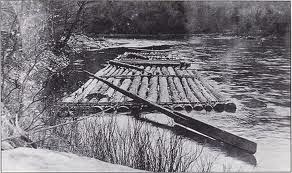
Before the canals were built, log rafts were quite large, but later rafts had to be smaller to fit through the canals. The logs that comprised the rafts were usually 60 feet long. Sometimes the rafts were built in sections called boxes. The complete rafts were floated downriver, broken into individual boxes to get them through the canals, then reassembled in the river at the end of the canals. A lumber company often sent gangs of rafts downriver together, and hired a crew to accompany them down the river. The crews usually consisted of a pilot, several raftsmen and a cook. The cook plied his trade on a little shanty built on one of the rafts. That raft was often the size of one box, so that it didn't have to be disassembled when going through the locks. (I couldn't find exactly what I wanted for a photo online. This one shows how the logs were joined together in sections. Each of these sections was called a box).

C.W. Bliss, a merchant in West Fairlee in the late 1800's, was a cook on a gang of rafts when he was 18. He told his story to historian Lyman Hayes, and it has been quoted in multiple publications since. There were 18 rafts and 18 men bringing them down the river. Bliss said that it took two men to navigate the rafts, so they brought nine rafts down the river as far as possible, catch a train back to the other nine, and then bring them down the river. The shanty divided in half, with one half used for cooking, and one half used for sleeping quarters, which consisted of straw thrown on the floor of the raft. C.W. cooked on an iron stove with an elevated oven. He bought white bread and made brown bread, cooked potatoes and beans, and tea and coffee. He says, “these constituted the whole bill of fare”.

The lumberman C.W. worked for was a man named Richardson, from Orford. He followed the rafts by train, but came aboard the shanty raft often. Bliss was hired at the “Wilder locks” to travel with the rafts as far as Holyoke. He was paid $1.50 a day and says that the pilots were paid $3.00 a day. There were two spots in the river that were especially dangerous. For these spots, Richardson hired local pilots who knew the rocks and currents intimately, and paid them to guide the rafts safely through those danger zones.

When they got to Bellows Falls, C.W. says it took three days for the men to break the rafts into boxes for the trip through the canal. The men all tried to be extra fast so that their raft would be the first to enter the canal. He says that there were close to five hundred people gathered on the sides of the river watching them work. This would seem to indicate that it was an unusually large shipment of rafts.

At sundown, many of the crew went in to Bellows Falls to drink at the many taverns that catered to the river trade. C.W. describes a half breed Indian named Sam Flint, a crew member who was 6 ft 4 inches tall and was very strong. He was a popular man when it was time to go into the town, as he was an intimidating body guard in the event of a bar fight.

At Holyoke, C.W. left the crew and headed home. Richardson had decided to ship the logs further down the river, to Middletown, Connecticut. Richardson asked C.W. To stay on, but he was done. He had signed on to see some of the country, but was ready to get back to his comfortable bed and his mother's home cooking in Corinth, Vermont.

C.W. Bliss grew up to own a store in West Fairlee. He was also an undertaker. Although his real name was Charles Wesley, most people knew him as “C.W.” In fact, his marriage license lists him as C.W. I have heard the story of C.W.'s trip down the Connecticut River before, and I have always wondered where he learned to cook and how he convinced Richardson to hire him to cook for a raft crew, as an 18 year old from Corinth.